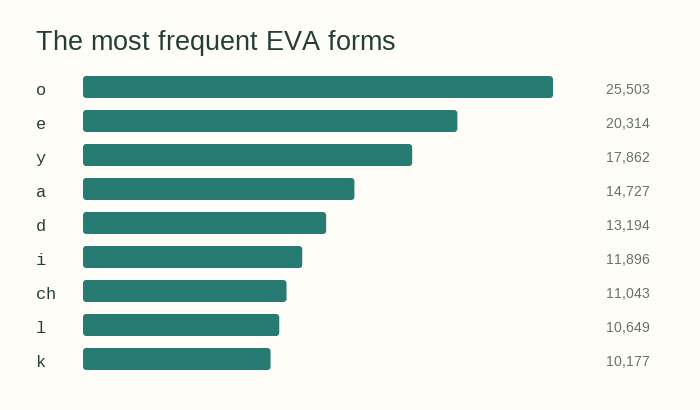
01 / How often does each sign occur?
EVA symbol frequencies
Compare glyph counts, sort the alphabet, and switch between individual EVA letters and grouped forms.
Explore chart →Download standalone HTML
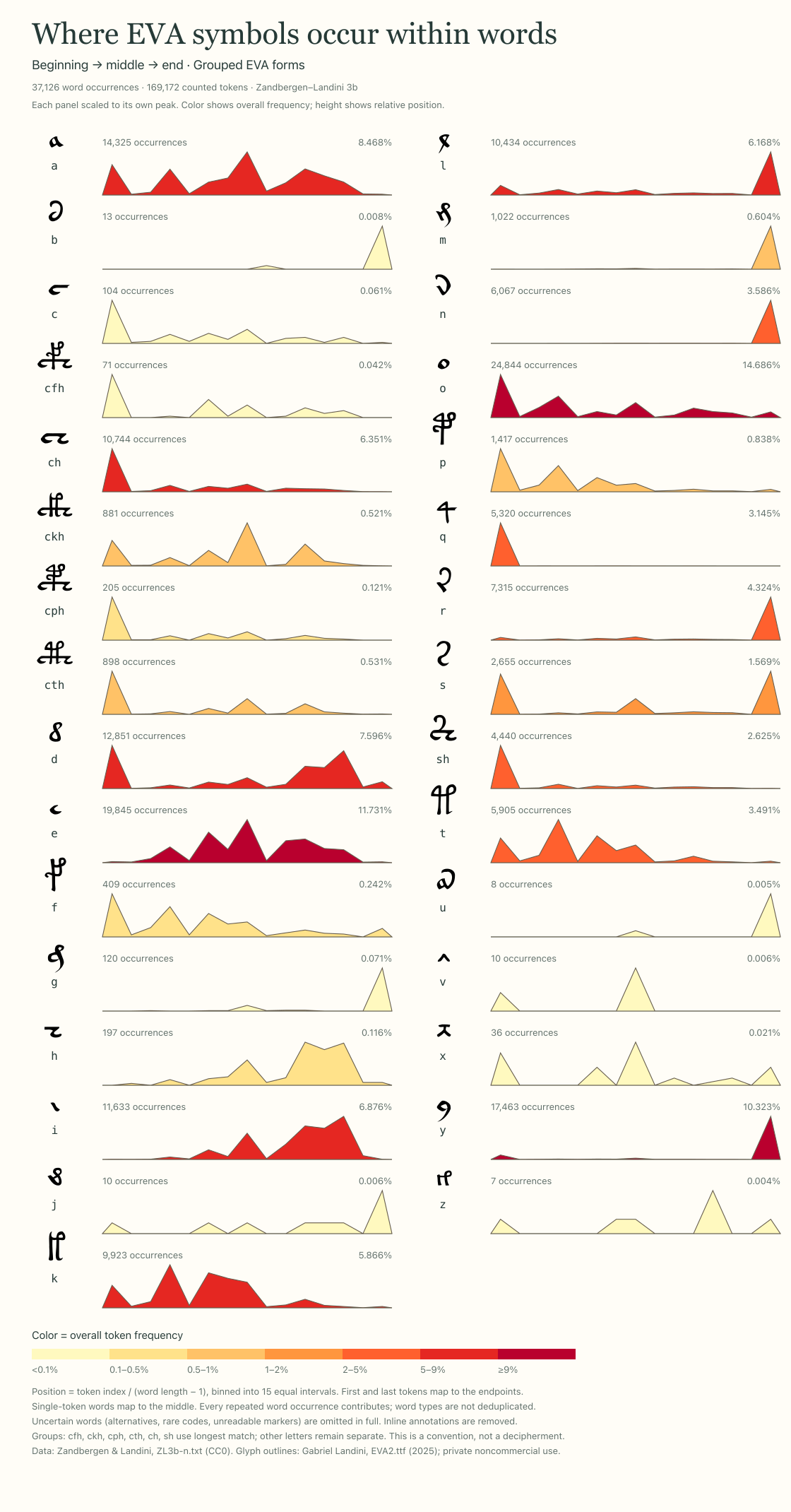
02 / Beginning, middle, or end?
Where symbols occur within words
Compare each sign’s positional profile in panels or stacked ridgelines. Sort alphabetically or by frequency, change units and scales, and export the current view.
Explore chart →Download standalone HTML
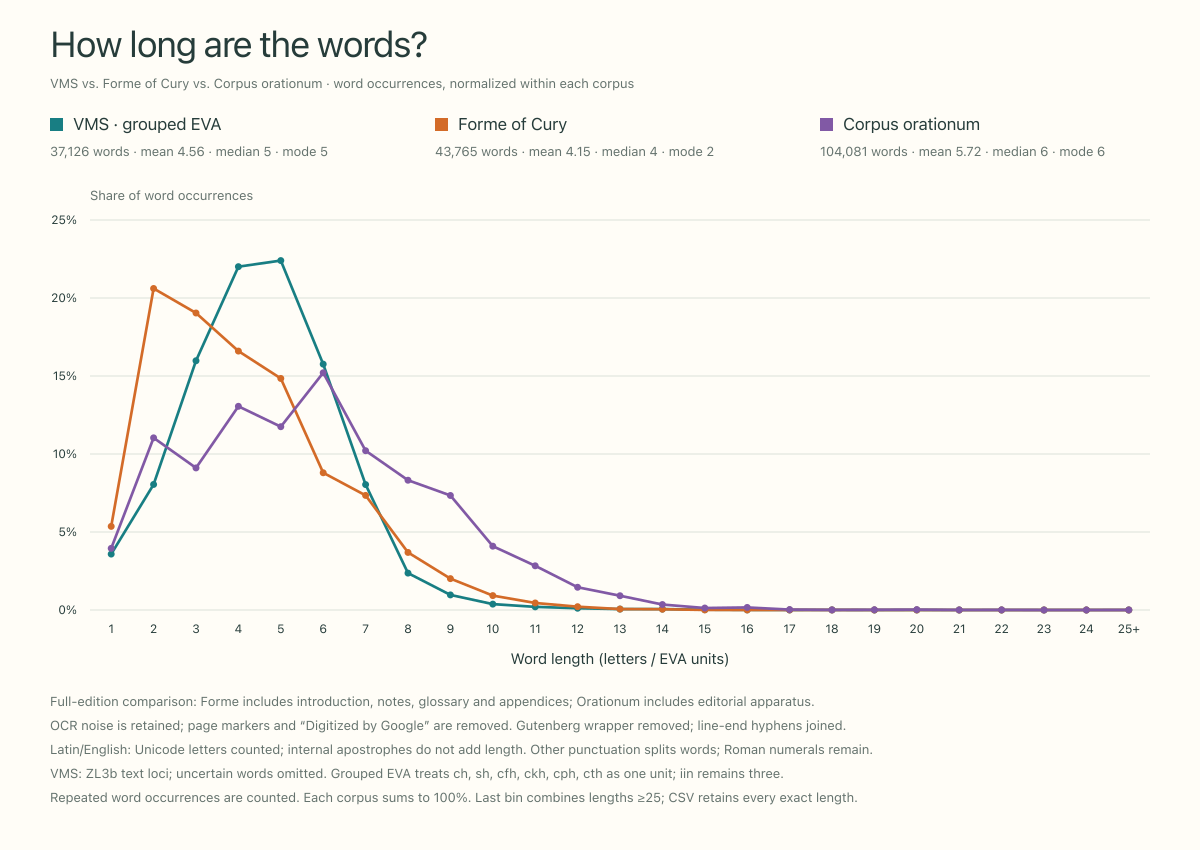
03 / VMS, Forme of Cury, and Orationum
Word lengths across corpora
Compare normalized word-length distributions, switch between lines and histograms, and inspect the effect of EVA segmentation.
Explore chart →Download standalone HTML
A page to read, not a chart to decode
The manuscript,
set in type.
fachys ykal ar ataiin
shol shory cthres y kor sholdy
Reading edition / folio by folio
Read the manuscript
A continuous glyph edition with adjustable type, optional EVA labels, and links from each word to its folio in Voynichese.
Open the reader →Character pairs ↔ whole-word triples
Predictable signs.
Elusive phrases.
h₂ = 2.11 bits · 1.03% exact triples
Three linked graphics / 339 language samples
What makes the statistics unusual?
Explore conditional entropy and side-by-side character-pair maps together, then compare exact three-word-window repetition with prefix-3 and suffix-3 forms.
Explore the statistics →Words → families → frequency
How much does
the tail change?
Four EVA sources. Fourteen treatments. Every family inspectable.
Rank curves / frequency histograms
Word frequency under transformations
Compare counts and relative abundance across transcriptions, learned families, rare-word repairs, prefixes, suffixes and word middles.
Explore word frequencies →Distributional classes / controlled experiments
Which signs
behave like vowels?
Blind alternation search, Sukhotin and HMM. Matched controls. No assumed decipherment.
Stability → neighbors → actual words
Vowel-like symbol discovery
Compare inferred classes across transcriptions, grouping and word interiors, inspect resampling stability, and test your own assignments.
Explore candidate classes →Context → probability → next sign
Follow the
next character.
Characters and spaces. First or second order. Step through the model.
Interactive Markov transitions
Spell with a transition model
Inspect outgoing probabilities, choose a sign or sample the next one, and compare four transcriptions with spaces included.
Explore the Markov diagram →Read the patterns with their assumptions.
EVA is a transliteration system, not a decipherment. Grouping signs changes the units being counted. Each chart explains its segmentation and cleaning rules; counts can differ between charts when uncertain words are excluded differently.
The VMS charts use Zandbergen–Landini 3b. The word-length comparison uses the supplied full editions of Forme of Cury and Corpus orationum, including editorial material and OCR noise. These charts are exploratory references.